








Aroma of Life: Reading Cities Through Smell

Mumbai was not merely travelled. It was inhaled — one station at a time. This EcoPlanet reflection explores how aroma carries memory, ecology, culture, hygiene, human activity, wellness and the living signature of a place.
Aroma of Life: Reading Cities, Nature and Wellbeing Through Smell
Mumbai is usually remembered through its local trains, crowded platforms, monsoon rain, sea breeze, markets, buildings, bridges and endless speed.
But there is another Mumbai — less visible, more intimate, and perhaps more truthful.
A Mumbai that was not only seen.
Not only heard.
Not only travelled.
It was smelled.
For many years, while travelling by local trains from Vashi to VT, from Borivali to Churchgate, and from Thane to Kurla, I often felt that every station had its own invisible identity. Even before seeing the station board, the air would begin to speak.
Each locality had an aroma.
Each creek had an aroma.
Each nala had an aroma.
Each market had an aroma.
Each industrial belt had an aroma.
Each railway platform had an aroma.
Each community had an aroma.
Each human activity had an aroma.
Some smells were pleasant. Some were uncomfortable. Some were harsh. Some were deeply nostalgic. But none of them were meaningless.
They were signals.
They carried stories of ecology, hygiene, food, work, faith, industry, class, culture, public health, memory and survival.
At EcoPlanetFarm, we look at aroma as part of ecological intelligence — a way to sense soil, water, plants, microbes, forests, cities and planet wellbeing.
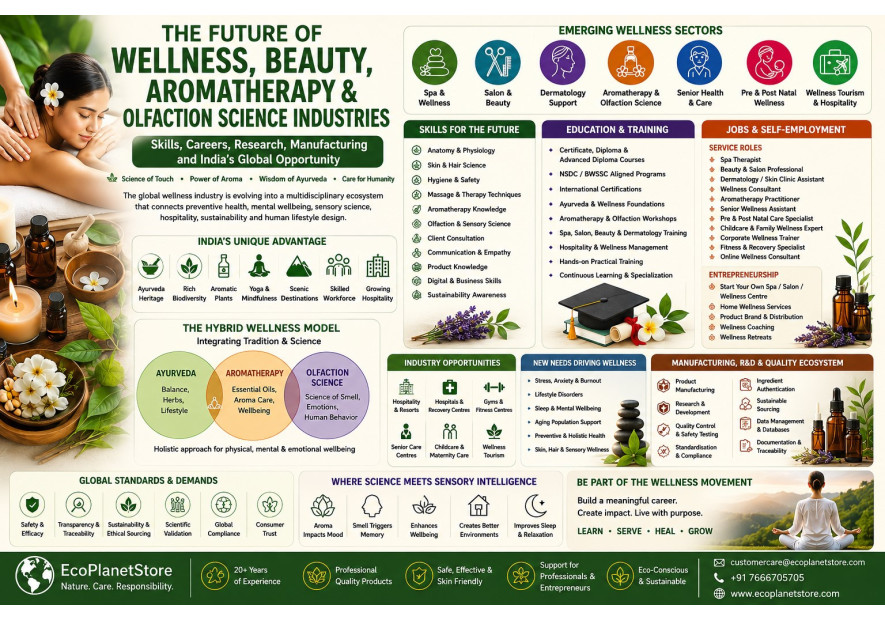
At EcoPlanetStore, we look at aroma as part of wellness and sensory science — a bridge between nature, memory, emotional wellbeing, beauty and professional care.
Together, they tell one deeper story:
Aroma is not just fragrance. Aroma is life speaking through invisible chemistry.
Smell Is the Memory of a Place
Smell has a strange power.
A photograph shows us what a place looked like.
A sound reminds us what a place sounded like.
But smell brings back the whole atmosphere.
One familiar smell can suddenly return us to a railway platform, a childhood lane, a school morning, a kitchen, a market, a monsoon day, a temple queue, a church entrance, a fish market, a bakery, a farm, or a forest after rain.
Many places we once knew have changed. Some factories have shut. Some creeks have become more polluted. Some old markets have transformed. Some station surroundings are now hidden under concrete, flyovers and redevelopment.
But their smell remains in memory.
That is why aroma is not only chemistry.
It is also nostalgia.
It is the emotional archive of a place.
A city may change its skyline, but the nose remembers its older breath.
Mumbai Was an Aroma Map: Vashi to VT
When I travelled from Vashi to VT, now CSMT, the journey was not just a railway journey. It was an aroma map.
Vashi carried the smell of planned Navi Mumbai — concrete, wet dust, young trees, morning roads, distant creek moisture and a city still finding its ecological rhythm.
As the train moved toward the creek before Mankhurd, the smell suddenly changed. The air opened. There was salt, wet mud, algae, marsh, mangrove, fish, tidal water and decomposition.
It was an awakening smell.
Not perfume.
Not artificial freshness.
But ecology.
A creek does not smell like a garden.
A creek smells like exchange.
Land meeting sea.
Fresh water meeting salt.
Life meeting decay.
Mud holding memory.
Mangroves breathing between survival and neglect.
Then came Mankhurd and Govandi, where the smell became heavier — marshland, waste edges, smoke, damp soil, cooking, drains, dense habitation and urban pressure. These were not just unpleasant odours. They were environmental reports written in air.
They spoke of hygiene.
They spoke of drainage.
They spoke of public health.
They spoke of how cities treat their edges.
Chembur had another signature — industrial memory, traffic, refineries in the distance, old colonies, trees, canteens, petrol, warm roads and domestic life. It was a mixture of industry and neighbourhood.
Tilak Nagar carried a softer residential smell — kitchens, soap, wet clothes, school mornings, flowers from balconies and commuters joining the city’s bloodstream.
Then came Kurla — powerful, crowded, metallic and human.
Kurla smelled of iron bridges, platforms, food stalls, sweat, leather bags, railway dust, wet newspapers, metal, frying snacks and movement. It smelled of labour. It smelled of people carrying the city before the city officially woke up.
Further ahead, Chunabhatti, GTB Nagar, Wadala Road, Sewri, Cotton Green, Reay Road and Dockyard Road each carried their own industrial and port-side breath — rust, oil, iron, grease, ropes, workshops, mills, warehouses, sea salt, old timber, mudflats and working-class life.
At Dockyard Road, the air had dignity. It smelled of labour, repair, port, sweat, metal and sea.
At Masjid Bunder, the aroma became dense and historical — kirana shops, spices, pulses, dry fruits, jaggery, sacks, old wood, crowd, trucks, sweat, packaging, commerce and memory.
Masjid did not smell like one market.
It smelled like generations of trade compressed into one morning.
Before VT, now CSMT, the fish market announced itself even before the station arrived — salt, scales, ice, baskets, wet floors, bargaining, sea and speed.
VT smelled of arrival.
Of railway history.
Of stone buildings.
Of office crowds.
Of fish markets.
Of old Bombay becoming daily survival.
The Western Line Had Another Breath: Borivali to Churchgate
The journey from Borivali to Churchgate had a different aroma biography.
Borivali carried the northern edge of the city — markets, temples, gardens, breakfast stalls, milk packets, commuters and the distant memory of Sanjay Gandhi National Park.
Kandivali, Malad and Goregaon carried residential density, construction dust, traffic, food stalls, old markets, malls and a city constantly rebuilding itself.
Jogeshwari, in certain stretches, carried the sharp memory of industry — chemical, synthetic and unmistakable. Some localities do not smell pleasant, but they warn us. They tell us that industry, waste, drainage and human settlement are meeting in ways that need attention.
Andheri smelled of ambition — airport movement, offices, perfume, sweat, traffic, fast food, studios and endless rush.
Vile Parle had one of Mumbai’s most unforgettable aroma memories — the warm, sweet, baked smell of Parle biscuits. Wheat, sugar, heat, factory and childhood came together in that smell. Few industrial smells become emotional. This one did.
Santacruz, Khar and Bandra had more layered neighbourhood aromas — sea breeze, bakeries, churches, flowers, fish, cafés, old homes, perfumes, rain-washed roads and morning movement.
The churchgoers carried a different floral aroma from the flowers near VT or Dadar. The flowers were different. The rituals were different. The soaps, fabrics, incense, baskets and morning rhythm were different.
A jasmine garland in a temple queue, a rose near a church, a marigold in Dadar market, a flower basket near VT, and a garland carried in a crowded train all become different once they enter culture.
Aroma changes when it enters human life.
Between Bandra and Mahim, the bridge over the creek carried a very different message — a filthy tidal smell of sewage, salt, mud, algae, trapped water, stagnation and urban neglect.
That smell was not merely bad smell.
It was a public health warning.
It was an urban planning failure.
It was a water body crying through smell.
Mahim carried creek, fish, dargah routes, churches, bakeries, old homes, traffic and tidal humidity.
Dadar was an aroma universe. The flower market before sunrise was one of Mumbai’s great sensory experiences — marigold, jasmine, rose, tuberose, wet petals, banana leaves, thread, baskets, devotion, sweat and wholesale speed.
Byculla vegetable market had another living chemistry — coriander, mint, cabbage, wet gunny bags, fruit peel, mud, vegetable sap and the freshness of food still connected to soil.
Further south, Lower Parel, Mahalaxmi, Mumbai Central, Grant Road, Charni Road, Marine Lines and finally Churchgate each carried different notes — mill memory, stables, long-distance travel, old cafés, temples, sea wind, college youth, office files and South Bombay elegance.
Churchgate was not VT.
If VT smelled of arrival, fish, trade, stone, crowd and survival, Churchgate smelled of sea breeze, office files, polished shoes, leather bags, perfume, old cafés, college corridors, church flowers and rain-washed pavements.
VT was the aroma of arrival.
Churchgate was the aroma of old urban grace.
Thane to Kurla: Lakes, Industry, Mangroves and Labour
The route from Thane to Kurla had yet another sensory character.
Thane carried lakes, old markets, moisture, traffic and water-body memory. It was urban, but still touched by hills and water.
Mulund had a residential-industrial balance — apartments, trees, markets, workshops and morning kitchens.
Nahur felt transitional — rail yards, dust, new development, open patches and commuting life.
Bhandup carried old industrial notes — machine oil, workshops, domestic mornings, factories and traffic.
Kanjurmarg once carried a strong manufacturing memory. In some stretches, the air reminded one of Godrej — soaps, oils, chemicals, machinery, packaging and organised industry.
Vikhroli mixed mangrove edges, greenery, traffic and industry. It was one of those places where urban ecology and industrial development stood close enough to share the same air.
Ghatkopar smelled of snacks, markets, incense, traffic, farsan, homes and busy commerce.
Vidyavihar brought colleges, canteens, paper, trees, students and youth.
And then again came Kurla — the great mixer of Mumbai.
Railways, roads, buses, markets, leather, sweat, food, drains, iron and movement all converged there.
Kurla was not one smell.
It was a mixing chamber of the city.
Dharavi, Nalas, Markets and Creeks: The City’s Hidden Chemistry
Passing through Dharavi, one could almost guess different activities by smell — leather, recycling, plastic, pottery, food, smoke, dampness, small workshops, domestic kitchens, drains and human density.
But Dharavi should never be reduced to filth.
Dharavi is also enterprise, craft, repair, recycling, labour, family, survival and resilience. Its aroma is complex because its life is complex.
Similarly, every nala, every creek, every market, every industrial lane, every railway edge tells a story.
A clean water body breathes differently.
A polluted creek breathes differently.
A living vegetable market breathes differently.
A dumping ground breathes differently.
A flower market breathes differently.
A factory belt breathes differently.
A mangrove edge breathes differently.
A healthy soil after rain breathes differently.
The smell of a place is never random.
It emerges from biological and non-biological activities — microbes, plants, algae, sewage, waste, food, combustion, chemicals, humidity, water flow, soil condition, animals, markets, factories and people.
Smell is a form of data.
It may not give us exact numbers like a laboratory instrument, but it gives us early signals. It tells us where something is alive, where something is decomposing, where something is stagnant, where something is polluted, where something is fresh, and where something is wrong.
The Human Aroma of Mumbai: Dabbawalas, Tiffins, Vendors and Commuters
Mumbai’s aroma was not created only by creeks, markets, industries and railway tracks.
It was also created by people.
The daily commuters carried their own invisible world into the local train — soap, sweat, talcum powder, coconut oil, perfume, wet clothes in monsoon, ironed shirts, leather bags, old newspapers, office files and the fatigue of early morning travel.
There was the smell of the office-goer’s tiffin — chapati, sabzi, dal, pickle, fried chillies, rice, coconut, curry leaves, mustard seeds, onions and home.
Before lunch hour, many compartments already carried the promise of food.
A steel tiffin is not just a container.
It carries the aroma of family, care, routine and survival.
The dabbawalas added another layer to Mumbai’s aroma map. Their crates, bicycles, uniforms, sweat, speed, railway platforms and thousands of home-cooked meals formed a moving food network.
The smell of dabbas was different from restaurant food. It was domestic, intimate and deeply human. It was the smell of homes travelling across the city to feed people at work.
Vegetable vendors on platforms and near stations carried the green smell of the day — coriander, mint, curry leaves, green chillies, wet gunny bags, tomatoes, brinjal, leafy vegetables, raw banana, onion skins and mud still clinging to produce.
Their baskets connected railway life to farms, mandis and morning labour.
The platforms themselves had changing food aromas — vada pav, bhajiya, samosa, cutting chai, bread omelette, poha, idli, chutney, roasted peanuts, bananas, biscuits and railway canteens.
Restaurants and food stalls along the tracks added their own smoke, spice, frying oil and breakfast rhythm.
Even the air near a station changed with time.
Early morning smelled of tea, wet tracks, soap, flowers, newspapers, milk cans, vegetable baskets and hurried footsteps.
Afternoon smelled of heat, metal, lunch boxes, sweat, dust and tired platforms.
Evening smelled of fried snacks, rain, exhausted bodies, perfume fading into sweat, office bags, crowded trains and the return journey home.
And then there was another kind of aroma — the aroma of conversations.
Daily commuters discussed office politics, salaries, cricket, elections, court matters, school admissions, stock markets, train delays, family problems, rising prices, illnesses, marriages, festivals and dreams.
These discussions had no chemical smell, but they had an emotional aroma.
Some conversations smelled of anxiety.
Some of ambition.
Some of humour.
Some of fatigue.
Some of survival.
Some of hope.
Mumbai’s local train was therefore not just a transport system.
It was a moving sensory ecosystem.
Every compartment was a mixture of food, labour, memory, hygiene, class, profession, season, fatigue, resilience and human closeness.
And perhaps this is why Mumbai’s smell was so unforgettable.
Because it was not only the smell of a city.
It was the smell of life moving.
Aroma, Hygiene and Public Health
Smell also tells us about hygiene.
A clean kitchen smells different from a neglected one.
A fresh market smells different from a rotting market.
A flowing creek smells different from a stagnant drain.
A composting system smells different from uncontrolled dumping.
A healthy farm smells different from chemically stressed land.
A well-kept locality smells different from one suffering from sewage, garbage and stagnant water.
This does not mean every bad smell is dangerous, or every pleasant smell is safe. Nature has many strong smells, and some dangerous pollutants may have little or no smell.
But smell is still an important early warning.
Persistent sewage smell may indicate drainage failure.
Rotten waste smell may indicate poor solid waste management.
Burning plastic smell may indicate toxic exposure.
Chemical odour may indicate industrial leakage or unsafe handling.
Stagnant water smell may indicate mosquito breeding and microbial risk.
Excess deodorising or artificial fragrance may sometimes be used to hide poor hygiene.
Aroma, therefore, is linked to health.
Not only personal health, but community health.
Not only beauty, but sanitation.
Not only fragrance, but public responsibility.
A city that smells constantly of sewage, smoke, rot or chemicals is telling us something. It is asking for attention.
The smell of a locality is its invisible report card.
Smell as Ecological Intelligence
Aroma is not only fragrance.
Aroma is ecological intelligence.
The smell of wet soil after rain tells us about microbes, moisture, minerals and organic matter.
The smell of a forest tells us about leaves, flowers, fungi, bark, resins, decomposition and plant volatiles.
The smell of a farm tells us about soil health, compost, plant stress, flowering, microbial life and biodiversity.
The smell of a creek tells us about tide, mud, algae, mangroves, sewage, fish and water quality.
The smell of a city tells us about hygiene, food systems, labour, industry, public health, waste management and inequality.
Before smart-city dashboards, air-quality apps, VOC sensors and satellite maps, the human nose was already reading the environment.
A farmer knows rain by smell.
A fisherman knows tide by smell.
A vegetable vendor knows freshness by smell.
A flower seller knows bloom quality by smell.
A factory worker knows leakage by smell.
A railway commuter knows locality by smell.
The nose is one of the oldest environmental sensors.
Of course, smell is not a complete scientific instrument. It must be supported by air testing, water testing, microbial analysis, VOC studies and public health data.
But as a first observer, the nose is extraordinary.
It notices change before instruments are installed.
It remembers patterns before data is collected.
It connects chemistry with lived experience.
From Ecology to Wellness
The same invisible chemistry that helps us read a city also shapes human wellbeing.
Aroma reaches memory quickly. It can remind us of childhood, rain, soil, flowers, markets, temples, churches, forests, kitchens, farms, sea breeze or home.
The smell of wet soil may calm us.
The smell of flowers may lift us.
The smell of citrus may feel fresh.
The smell of herbs may feel cleansing.
The smell of wood may feel grounding.
This is why aroma matters deeply in wellness, beauty, spa and personal care.
A spa product is not just cream.
A massage oil is not just oil.
A scrub is not just exfoliation.
An essential oil blend is not just smell.
Each product creates a sensory environment.
It touches the skin.
It enters memory.
It influences mood.
It changes the feeling of a room.
It becomes part of professional care.
Good aroma design is not about overpowering fragrance.
It is about balance.
Too much aroma can disturb.
Too little may not communicate.
Wrong aroma can confuse.
Right aroma can create trust, comfort, freshness, luxury, hygiene, wellness and memory.
Aroma is powerful, but it must be used with knowledge. Essential oils and aromatic ingredients are complex natural materials. Their use requires formulation understanding, dosage discipline, skin compatibility, product stability and professional care.
Aroma should not be treated casually.
It should be respected scientifically.
Aroma and Existence
Every living system announces its existence through some form of smell.
Soil has a smell.
Rain has a smell.
Leaves have a smell.
Flowers have a smell.
Animals have a smell.
Food has a smell.
Human bodies have a smell.
Homes have a smell.
Markets have a smell.
Temples, churches and mosques have their own smell.
Hospitals, schools, farms, forests, factories and railway stations all have their own smell.
To smell a place is to sense that it exists.
Aroma is one of the ways life declares itself.
A completely odourless world would feel sterile, disconnected and almost lifeless. It may look clean, but it may not feel alive.
At the same time, a foul-smelling world tells us that something in the system is disturbed — waste is unmanaged, water is stagnant, air is polluted, hygiene has failed, or decomposition has crossed into neglect.
So aroma sits at the boundary between life and decay, culture and pollution, memory and warning, comfort and discomfort.
It tells us not only what is pleasant.
It tells us what is happening.
From Mumbai to EcoPlanet
This memory of Mumbai’s station-wise aroma is not nostalgia alone. It is part of a larger scientific and ecological understanding.
At EcoPlanetFarm, we observe soil, plants, insects, flowers, rain, heat, microbes, forest edges and aroma as part of one living system.
A mango bloom has an aroma.
A stressed plant has a changed aroma.
Healthy soil has a smell.
Compost has a smell.
A forest after rain has a smell.
A farm under heat stress has a smell.
A flowering season has a smell.
A polluted place has a smell.
Aroma connects the invisible chemistry of life with human perception.
At EcoPlanetStore, this same understanding is carried into aromatherapy wellness and beauty products for professional use. Aroma is not used merely to make a product smell pleasant. It is used to create a meaningful sensory experience — one that respects nature, formulation science, professional care and human wellbeing.
EcoPlanetFarm studies the breath of nature.
EcoPlanetStore applies the science of aroma into wellness and beauty.
One observes the living landscape.
The other transforms aromatic knowledge into professional products.
Both are connected by the same belief:
Aroma is a bridge between nature, science, memory and wellbeing.
A City Remembered Through Breath
Mumbai was not merely travelled.
It was inhaled.
From Vashi to VT.
From Borivali to Churchgate.
From Thane to Kurla.
Across creeks, nalas, markets, factories, slums, ports, flower markets, vegetable markets, biscuit factories, churches, stations and railway bridges.
The city revealed itself one breath at a time.
The creek before Mankhurd.
The labour smell of Kurla.
The industrial memory of Chembur.
The port-side dignity of Dockyard Road.
The kirana richness of Masjid Bunder.
The fish market before VT.
The flower universe of Dadar.
The biscuit warmth of Vile Parle.
The filthy warning of Mahim Creek.
The refined sea breeze of Churchgate.
The manufacturing memory of Kanjurmarg.
The complex enterprise of Dharavi.
The vegetable freshness of Byculla.
The dabbawalas carrying home-cooked meals across the city.
The office tiffins carrying family and care into workplaces.
The commuters carrying soap, sweat, perfume, fatigue and hope.
The tidal vastness between Bhayander and Vasai.
Together, they formed an invisible biography of the city.
Not always pleasant.
Not always clean.
Not always comfortable.
But true.
And that is the power of aroma.
It does not flatter.
It reveals.
Conclusion: The Aroma of a Place Is Its Living Signature
Every place breathes.
A forest breathes through leaves, flowers, soil and microbes.
A farm breathes through crops, compost, insects and rain.
A creek breathes through tide, mud, algae and mangroves.
A market breathes through food, flowers, people and waste.
A city breathes through traffic, labour, industry, drains, kitchens, rituals and memory.
A local train breathes through commuters, tiffins, conversations, sweat, perfume, fatigue and hope.
A wellness space breathes through oils, herbs, flowers, products, touch and care.
The aroma of a place is its living signature.
It tells us what is alive.
What is decaying.
What is polluted.
What is fresh.
What is neglected.
What is sacred.
What is industrial.
What is human.
What is natural.
To heal land, we must first learn to sense it.
To understand cities, we must learn to read their breath.
To create meaningful wellness, we must respect the science and memory of aroma.
Mumbai was not merely a city I travelled through.
It was a living laboratory of smell, ecology, people, industry, water, markets, labour, food, conversation, hygiene, culture and memory.
And perhaps every city, every farm, every forest, every product and every locality is asking us the same question:
Can you smell what is happening to me?
EcoPlanetFarm — Ecological observation, regenerative farming, aroma intelligence and planet wellbeing.
EcoPlanetStore — Professional aromatherapy wellness and beauty products inspired by nature, science and sensory care.
